
I recently completed an online course from The Wharton School of the University of Pennsylvania led by Mauro Guillén, and one crucial part of this programme that particularly caught my attention was the dissection of the nearly exponential rise in the middle class, especially in India.
Defined by the professor as “the segment between the peasantry and the working class, on the one hand, and the upper class” (specifically people with at least $10 to spend per day, but no more than $100), the middle class is the largest consumer demographic of the 21st century. As a part of this blog, I will discuss some of the causes that led to this increase and what this means for our world from a geo-political and economic lens.
Economic Liberalisation
The world has seen a rapid rise in India’s middle class since the late 20th century (at 6.3% per year) and this change in demographic can be pinpointed to several causes. Although the course mentioned that the key causes are the growth of cities and the new occuptations created in them, there is another factor that led to this increase that I believe is worth mentioning, which is the Economic Liberalisation of 1991.

The single most transformative event was India’s 1991 LPG reforms (Liberalisation, Privatisation, Globalisation). These reforms opened the Indian economy to multinational corporations, creating a wave of new job opportunities (especially in services and IT sectors) and dramatically expanded the middle class, particularly in urban areas. Before this, India had a heavily protected, state-controlled economy that suppressed private wealth creation.
“Cockiness” in the consumer market?
In Module 2 of the course, the professor mentioned a piece of information that was really crucial and engrossing in relation to this topic; through an economic and financial perspective, the members of the middle class are not wealthy, and most individuals, with at least $10 to spend but no more than $100, acknowledge and accept this. This is seen through their use of purchasing power; they don’t buy luxurious goods and services. However, this brings me to my next point, which is that this doesn’t mean that they consider themselves to be poor. In fact, they believe that the financial gap between them and the lower income class is
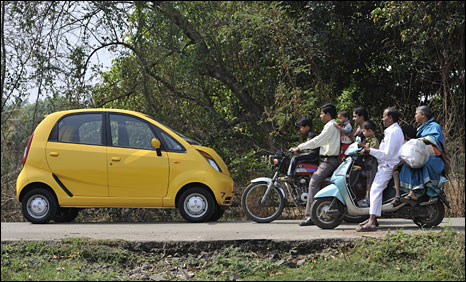
A recent case study that demonstrates this mentality is the Tata group; a TNC with its HQ in India. In 2008, the company developed the “Tata Nano”, a micro car, with a relatively cheap price ($2,500), targeted to Indian middle class families that need to get around quickly at a low cost. The middle class in response, however, considered this product to be directed towards the lower class, believing that its cheapniess would come to the demographics convenience.
What does this mean for businesses?
As a result of the Tata Nano rejection, the company lost thousands in revenue, with most believing that being seen in the “world’s cheapest car” felt like a step backward, not forward. This failure connects to two key business models that Tata Nano and other companies must take into consideration:
Aspirational economy
The case study shows how the Indian middle class is not a budget market; it is an aspirational market. Consumers in this segment are acutely aware of branding and especially perceived quality. Research shows that Indian middle-class consumers often trade up, not down; they will stretch their budgets for a brand that confers status. This is why Apple iPhones, despite being significantly more expensive than local alternatives, have seen explosive growth in India. Sales reportedly grew over 40% in FY2024, making India one of Apple’s fastest-growing markets globally.
The pressure on pricing strategy
The Nano case illustrates a broader trap for businesses: the “cheap = inferior” perception. Companies targeting the Indian middle class cannot simply strip down a product and lower the price. Instead, successful businesses have adopted what strategists call “value with dignity”, which is essentially offering affordability packaged within a premium-feeling experience. Maruti Suzuki understood this far better than Tata. Models like the Swift and Dzire were priced accessibly but marketed as modern, stylish, and desirable, and they consistently dominated Indian car sales charts as a result.
The central lesson for businesses is that the rising Indian middle class is not simply a larger version of a poor consumer base. It is a psychologically distinct, brand-conscious, status-aware demographic that demands to be treated as such. Companies that understand this, and build for aspiration rather than just affordability, are the ones positioned to capture one of the most consequential consumer markets of the 21st century.
What does this mean for governments
The rapid expansion of India’s middle class presents governments, both domestically and internationally, with a profound shift in political and economic responsibility.
At home, the Indian government faces growing pressure to deliver on the expectations of a demographic that is educated and increasingly vocal. Unlike poorer populations that may prioritise basic survival needs, the middle class demands better healthcare systems, higher-quality public education, reliable infrastructure, and reduced corruption, not to mention that they have the awareness and platforms to hold governments accountable when these are not delivered. This creates both an opportunity and an obligation: a thriving middle class generates significantly higher tax revenues, reducing reliance on foreign aid and enabling greater public investment, but it also demands more in return.
For foreign governments, particularly in the West, a billion-strong Indian middle class by 2047 represents a geopolitical realignment; India becomes too large a consumer market, too significant a trading partner, and too influential a diplomatic voice to be treated as a developing nation afterthought. Countries are already repositioning trade agreements, visa policies, and foreign direct investment strategies with one eye firmly on India’s middle-class trajectory.
The takeaway
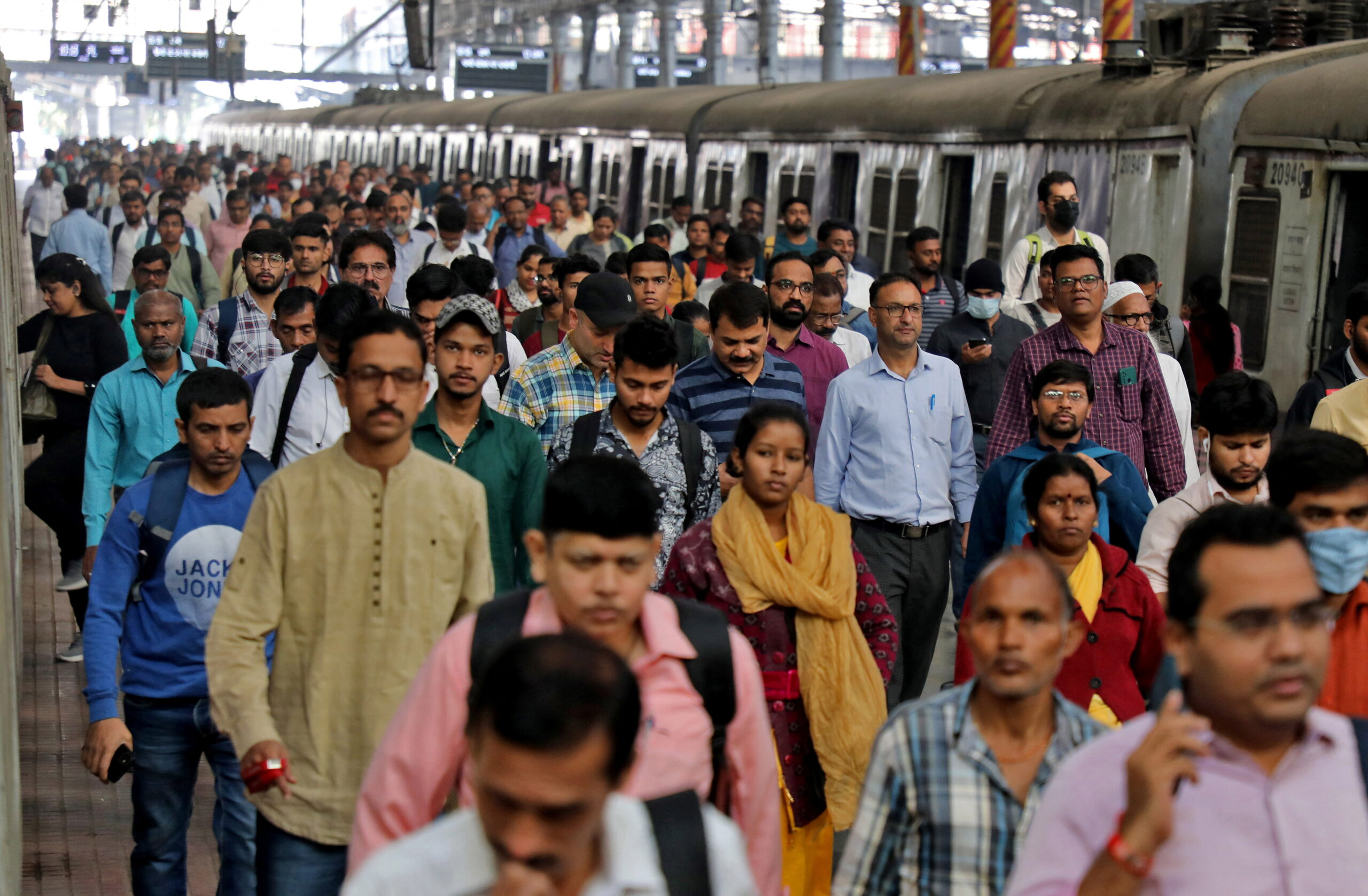
The Indian middle class is expected to increase to 60% by 2047. By 2030, 700 million more people are expected to join the global middle class. This rapid shift in demographic means that governments around the world have already started or will soon potentially start establishing and reinforcing policies to ensure, and businesses have to consider the voice of the middle class before commencing with any major decisions (to ensure that they do not lose money). The increasing middle class is no longer a market to be discovered; it is a force to be reckoned with.




 The Market Lens
Leave a comment